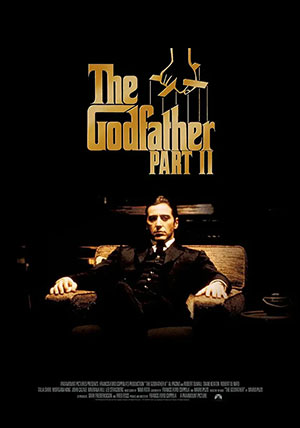

The Godfather Part II (1974)

Crime/Drama
Profile by John Doe
★9
Recommendation 124.6K
The Godfather Part II

Release Date: 19741220

Director: Francis Ford Coppola

Cast: Al Pacino, Robert De Niro, Robert Duvall, Diane Keaton

Production: Paramount Pictures, The Coppola Company

Synopsis of the The Godfather Part II

The film weaves two parallel timelines, tracing the dual fates of the Corleone family across generations. In the early 1900s, a young Vito Corleone flees Sicily after his family is massacred by the local mafia, arriving in New York as an impoverished immigrant. With quiet wit, unwavering loyalty, and a knack for seizing opportunities, Vito gradually builds a modest empire—first running errands for local merchants, then standing up to ruthless gangsters who exploit his community. His rise is rooted in protection and reciprocity, earning him the respect of fellow immigrants who come to see him as a guardian. Meanwhile, decades later, Vito’s son Michael Corleone sits atop the Corleone empire, but the throne is a lonely one. Haunted by his father’s legacy and the blood on his hands, Michael expands the family’s business into Cuba, only to face betrayal, political upheaval, and increasing paranoia. As he eliminates rivals and even doubts his own brother Fredo, his marriage to Kay collapses, and the warmth and loyalty that defined Vito’s reign are replaced by cold, authoritarian control. The two timelines converge in stark contrast: Vito’s journey is one of survival and community building, while Michael’s is a descent into isolation and moral decay. By the film’s end, Michael has secured the family’s power, but lost everything that made the family worth protecting.

Detailed Review & Analysis

《The Godfather Part II》is not just a sequel or a gangster epic—it’s a profound meditation on legacy, power, and the erosion of soul across generations, using dual timelines to create a tragic mirror that reflects the corruption of the American dream. Unlike the moral philosophy of《The Dark Knight》, the spatial metaphor of《Gezhi Town》, or the black humor of war dramas, this film adopts a slow-burning, elegiac tone, with muted cinematography and a haunting score that underscores the inescapable tragedy of the Corleone story. Have you ever wondered if we are doomed to repeat the mistakes of our ancestors? Or if power inevitably corrupts the very values we set out to defend? These questions hang over every frame, as Vito’s hard-won humanity stands in sharp contrast to Michael’s hollowed-out ambition. The sensory details are rich and evocative: the sun-dappled streets of early 20th-century New York’s Little Italy, the smell of fresh bread from Vito’s first small business, the cold marble halls of Michael’s Lake Tahoe compound, the tension in the air during Michael’s quiet, menacing conversations, the silence of Kay’s departure as she leaves the family forever. The film’s greatest strength is its dual character study: Vito is not a perfect hero, but a man who balances toughness with compassion, his power rooted in trust; Michael is not a simple villain, but a tragic figure who begins with the desire to protect his family and ends up destroying it from within. Their parallel journeys reveal the cruel irony of legacy—what Vito built to shield his loved ones becomes the cage that traps Michael. Yet it’s not without flaws: the dual timelines can be disorienting for first-time viewers, and some supporting characters in Michael’s storyline feel underdeveloped. Compared to films that focus on external conflict or grand philosophical debates,《The Godfather Part II》is an intimate portrait of a family’s soul, exploring how the very things that bind us—loyalty, tradition, love—can become the instruments of our undoing. When Michael sits alone in his compound, surrounded by power but utterly isolated, it’s a moment more devastating than any gunfight, a reminder that legacy is both a gift and a curse. This film endures because it understands that the greatest tragedies are not those imposed by external forces, but those we bring upon ourselves in the name of love and duty. Long after the credits roll, you’ll find yourself thinking of Vito’s quiet smile as he helps his neighbors, and Michael’s empty gaze as he loses everything, a haunting reminder that power without humanity is nothing but a prison.

Related Movies

Write a Comment (0)

0/200
☆ ☆ ☆ ☆ ☆
0/10

No comments yet. Be the first to comment!