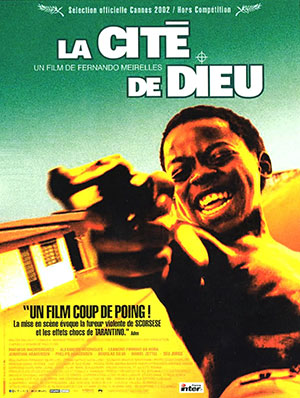


City of God (2002)

Crime/Drama
Profile by John Doe
★8.6
Recommendation 87.7K
City of God

Release Date: 20020830

Director: Fernando Meirelles, Kátia Lund

Cast: Alexandre Rodrigues, Leandro Firmino, Phellipe Haagensen, Douglas Silva

Production: Miramax Films, O2 Filmes

Synopsis of the City of God

Set in the City of God, a violent, poverty-stricken favela on the outskirts of Rio de Janeiro, the film traces the lives of a group of young people navigating a world ruled by drugs, gangs, and senseless brutality. The story unfolds through the eyes of Rocket, a mild-mannered boy with a passion for photography, who observes the chaos around him while striving to avoid being consumed by it. As the years pass, Rocket witnesses the rise and fall of various gang leaders: Li'l Zé, a ruthless and ambitious criminal who ascends to power through ruthless violence, eliminating rivals and establishing a drug empire; and Benny, Li'l Zé's charismatic right-hand man, who dreams of escaping the favela's violence. The favela becomes a battlefield where children are recruited as soldiers, disputes are settled with guns, and life is cheap. Rocket's path intersects with these dangerous figures repeatedly, and he must use his wits and his camera to survive. Amidst the bloodshed, a brutal gang war erupts, threatening to destroy the entire community. Rocket's photography soon becomes a way to document the harsh reality of the City of God, offering him a potential ticket out of the favela—if he can stay alive long enough to seize it.

Detailed Review & Analysis

City of God is far more than a gritty crime drama; it's a harrowing, unflinching portrait of how poverty and systemic neglect create cycles of violence that devour generations, and the fragile possibility of hope in the darkest of circumstances. Unlike conventional gangster films that romanticize power or redemption, this film presents violence not as a choice, but as a suffocating environment—a birthright that children in the favela inherit, with few paths to escape. What sets it apart is its documentary-like realism; the use of non-professional actors, kinetic cinematography, and a fragmented narrative structure plunges the audience directly into the chaos of the City of God, making the suffering and despair feel visceral and unavoidable. Unlike works that focus on individual heroism, the film emphasizes the collective tragedy of the favela: every character, from the ruthless Li'l Zé to the innocent children drawn into gang life, is a victim of a system that has abandoned them. The film's greatest strength lies in its refusal to offer easy answers or sentimental hope; instead, it shows that breaking the cycle of violence requires more than individual courage—it demands systemic change. What makes it unforgettable is its portrayal of childhood lost: the way young boys trade toys for guns, and the way innocence is eroded by constant exposure to death. Long after the credits roll, what lingers isn't just the shock of the violence, but the haunting realization that the City of God is not an isolated nightmare, but a product of societal failure. It's a film that forces viewers to confront the uncomfortable truth that violence thrives where opportunity is scarce, and that the line between victim and perpetrator is often blurred by circumstance. Rocket's photography, in the end, isn't just a personal escape—it's a testament to the importance of bearing witness, of refusing to let the world ignore the suffering of those trapped in the margins.

Related Movies

Write a Comment (0)

0/200
☆ ☆ ☆ ☆ ☆
0/10

No comments yet. Be the first to comment!