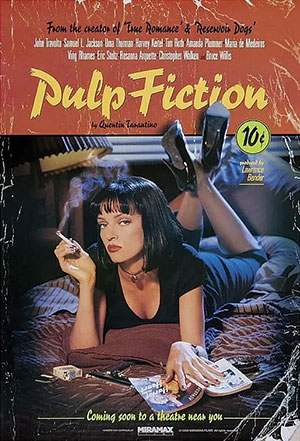


Pulp Fiction (1994)

Crime/Drama
Profile by John Doe
★8.9
Recommendation 165.4K
Pulp Fiction

Release Date: 19941014

Director: Quentin Tarantino

Cast: John Travolta, Samuel L. Jackson, Uma Thurman, Bruce Willis

Production: Miramax Films, A Band Apart, Jersey Films

Synopsis of the Pulp Fiction

Set in the seedy underbelly of Los Angeles, the film weaves together three interconnected, non-chronological stories that revolve around crime, violence, and unexpected moments of humanity. Vincent Vega, a hitman fresh off a trip to Europe, is tasked by his gangster boss Marsellus Wallace with accompanying Marsellus’ wife Mia for a night out—an assignment fraught with unspoken danger. Meanwhile, Vincent and his partner Jules Winnfield carry out a mission to retrieve a mysterious briefcase for Marsellus, a job that takes a surreal turn after a near-death experience forces Jules to question his life of crime. Parallel to their story, Butch Coolidge, a washed-up boxer paid by Marsellus to throw a fight, betrays the gangster and goes on the run with his girlfriend Fabienne, only to find himself trapped in a deadly confrontation when he returns to retrieve a cherished family heirloom. As the narratives fold back on themselves, overlapping characters and coincidences reveal the chaotic, unpredictable nature of fate, blending brutal violence with sharp dialogue and dark humor in a world where right and wrong are as muddled as the timeline.

Detailed Review & Analysis

Pulp Fiction transcends the boundaries of a typical crime film, emerging as a subversive exploration of moral ambiguity, fate’s absurdity, and the fragile humanity hidden within even the most hardened criminals. Unlike conventional linear narratives that prioritize plot resolution, this film uses its fragmented structure to mirror the chaos of its world, forcing viewers to piece together the story and question the arbitrary nature of cause and effect. What sets it apart is its rejection of black-and-white morality; none of the characters are heroes or villains—they are flawed, contradictory individuals who stumble through violence and chance,偶尔 grappling with moments of conscience that feel both genuine and absurd. Unlike works that use violence for shock value, the film’s brutal scenes are balanced with razor-sharp dialogue and quiet, intimate moments: Vincent and Mia’s awkward yet tender dance, Jules’ monologue on divine intervention, Butch’s desperate quest to reclaim his father’s watch. These moments strip away the tough-guy personas, revealing the loneliness and uncertainty beneath. The film doesn’t glorify crime; instead, it presents it as a cycle of emptiness, where violence begets violence and even moments of redemption are fleeting. What makes it unforgettable is its celebration of the mundane within the extraordinary—how a trip to a diner, a dance contest, or a lost watch can become pivotal in lives defined by chaos. Long after the credits roll, what lingers isn’t just the iconic scenes or quotable lines, but the realization that in a world without order, humanity survives in the smallest, unlikeliest moments of connection. It’s a film that defies categorization, challenging viewers to embrace ambiguity and find meaning in the messiness of life.

Related Movies

Write a Comment (0)

0/200
☆ ☆ ☆ ☆ ☆
0/10

No comments yet. Be the first to comment!