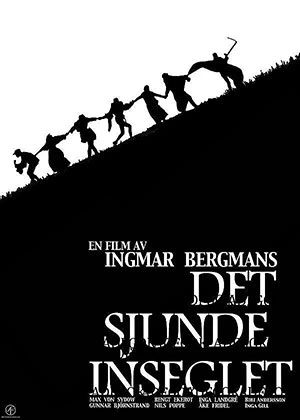

The Seventh Seal (1957)

Drama/Fantasy
Profile by John Doe
★8.2
Recommendation 32.1K
The Seventh Seal

Release Date: 19570216

Director: Ingmar Bergman

Cast: Max von Sydow, Gunnar Björnstrand, Bengt Ekerot, Nils Poppe

Production: Svensk Filmindustri

Synopsis of the The Seventh Seal

Returning home to Sweden after years of fighting in the Crusades, Antonius Block, a disillusioned knight, finds his homeland ravaged by the Black Death. Weary, spiritually adrift, and haunted by doubt in God’s existence, he encounters Death—a pale, robed figure—on a desolate beach. Refusing to surrender without confronting his existential despair, Block challenges Death to a game of chess, bargaining that he will keep his life for as long as the game lasts. As the pair traverse the plague-stricken countryside, the chess match unfolds in intermittent rounds, with Block using the time to seek answers to life’s greatest questions: Is there a divine purpose? Does faith offer solace in the face of inevitable death? Along the way, he encounters a cast of vivid characters: Jöns, his cynical squire who embraces life’s pleasures amid chaos; Mia and Jof, a young, joyful couple with a baby, whose simple happiness contrasts sharply with Block’s torment; and a band of traveling actors grappling with fear and morality. As the game nears its end and Death’s victory seems inevitable, Block struggles to find meaning in a world stripped bare by suffering, hoping to perform one meaningful act before his time runs out.

Detailed Review & Analysis

The Seventh Seal transcends the boundaries of a medieval drama, emerging as a timeless allegory of humanity’s relentless search for meaning in the shadow of mortality, and the fragile balance between faith and doubt. Unlike conventional existential narratives that lean into bleakness or blind optimism, this film confronts the absurdity of human existence with unflinching honesty, using the chess match with Death not just as a plot device, but as a metaphor for life’s fleeting, strategic dance with mortality. What sets it apart is its refusal to resolve the tension between faith and doubt; instead, it presents both as integral to the human condition—Block’s spiritual agony is not a flaw, but a testament to his refusal to accept empty dogma. Unlike works that frame death as an enemy to be defeated, the film portrays it as an inescapable, almost quiet companion, whose presence amplifies the value of fleeting human connections. The film’s power lies in its stark visual poetry: the desolate landscapes, the haunting imagery of the plague, and the quiet moments of joy—Mia feeding Block wild strawberries, Jof’s gentle lullaby to his child—that cut through the despair. What makes it unforgettable is its rejection of easy spiritual answers; it doesn’t confirm or deny God’s existence, but rather explores the courage required to keep searching for meaning even when answers elude us. Long after the credits roll, what lingers isn’t just the iconic chess match, but the realization that meaning is not found in grand revelations, but in the small, human acts of love, kindness, and connection we cherish along the way. It’s a film that honors the agony of doubt as much as the comfort of faith, reminding us that to question is to be human—and that even in the face of inevitable death, the choice to engage with life fully is an act of defiance and grace.

Write a Comment (0)

0/200
☆ ☆ ☆ ☆ ☆
0/10

No comments yet. Be the first to comment!