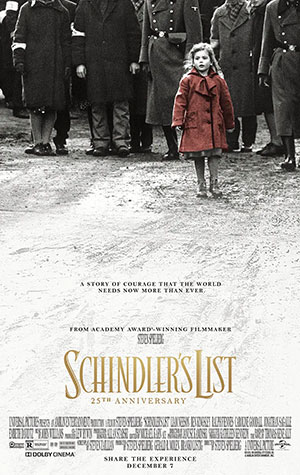

Schindler's List (1993)

Biography/Drama/History
Profile by John Doe
★9
Recommendation 156.8K
Schindler's List

Release Date: 19931215

Director: Steven Spielberg

Cast: Liam Neeson, Ralph Fiennes, Ben Kingsley, Caroline Goodall

Production: Universal Pictures, Amblin Entertainment

Synopsis of the Schindler's List

Set against the horrors of Nazi-occupied Poland during World War II, the film traces the journey of Oskar Schindler, a charismatic, profit-seeking German businessman with a penchant for luxury and influence. Schindler arrives in Kraków with ambitions of building a successful enamelware factory, leveraging cheap Jewish labor and his connections to the Nazi elite to maximize profits. Initially indifferent to the plight of the Jews, he views them as a means to an end, treating his workers with detachment while currying favor with high-ranking Nazis like Amon Göth—a ruthless SS officer overseeing the Kraków Ghetto. As Schindler witnesses the escalating brutality of the Nazi regime, from the liquidation of the ghetto to the mass deportation of Jews to concentration camps, a profound transformation takes hold of him. Haunted by the suffering he can no longer ignore, Schindler abandons his profit-driven motives and embarks on a desperate mission to save as many Jewish lives as possible. He uses his wealth, influence, and cunning to compile a 'list' of Jewish workers deemed 'essential' to his factory, shielding them from deportation to Auschwitz and certain death, even as the war winds down and his own safety becomes increasingly precarious.

Detailed Review & Analysis

Schindler's List transcends the boundaries of a Holocaust drama, emerging as a profound meditation on moral awakening and the quiet heroism of choosing compassion in the face of unspeakable evil. Unlike conventional narratives that frame heroism as grand, triumphant acts, this film celebrates the gradual, imperfect transformation of a flawed man—one who begins as a self-serving opportunist and evolves into a savior through small, deliberate choices. What sets it apart is its refusal to romanticize Schindler’s journey; his heroism is rooted in guilt, regret, and a belated recognition of his own complicity in a system of oppression, making his redemption all the more human and resonant. Unlike works that reduce the Holocaust to a spectacle of suffering, the film’s power lies in its intimate focus on individual lives—the quiet dignity of the Jewish workers, the casual cruelty of Göth, and Schindler’s internal struggle between self-preservation and doing what is right. The black-and-white cinematography amplifies this intimacy, stripping away visual distraction to lay bare the raw humanity of the story. What makes it unforgettable is its exploration of moral ambiguity; Schindler is not a perfect hero, and the Nazis are not one-dimensional monsters—both are products of a dehumanizing system that tests the limits of individual conscience. Long after the credits roll, what lingers isn’t just the heart-wrenching scenes of suffering, but the haunting realization that heroism is not reserved for the righteous, but for those who choose to act, even when it’s too late to undo the harm they’ve witnessed. It’s a film that reminds us that compassion can flourish even in the darkest of times, and that every life saved is a victory against the forces of dehumanization—proof that humanity, however fragile, can never be fully extinguished.

Related Movies

Write a Comment (0)

0/200
☆ ☆ ☆ ☆ ☆
0/10

No comments yet. Be the first to comment!