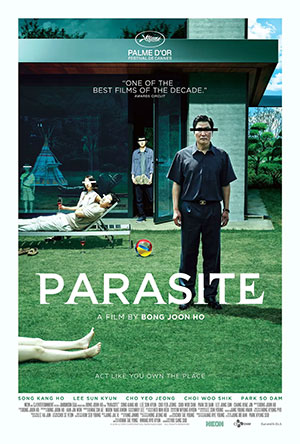


Parasite (2019)

Comedy/Drama/Thriller
Profile by John Doe
★8.5
Recommendation 134.6K
Parasite

Release Date: 20190530

Director: Bong Joon-ho

Cast: Song Kang-ho, Lee Sun-kyun, Cho Yeo-jeong, Choi Woo-shik

Production: CJ Entertainment, Barunson E&A

Synopsis of the Parasite

In the cramped, squalid semi-basement of Seoul, the Kim family struggles to make ends meet, folding pizza boxes for meager pay and stealing Wi-Fi from neighboring buildings. Their fortunes take an unexpected turn when Ki-woo, the family's son, lands a job as an English tutor for the daughter of the wealthy Park family, thanks to a recommendation from his college friend. Recognizing an opportunity to escape poverty, Ki-woo, with the help of his sister Ki-jung's forged credentials, schemes to get his sister hired as the Parks' art therapist. One by one, the Kim family members—disguised as unrelated, highly qualified professionals—infiltrate the Park household, replacing the existing staff and siphoning off the Parks' wealth. What begins as a clever, comedic con evolves into a tense, unpredictable nightmare when the Kims discover a shocking secret hidden in the Parks' luxurious home. As the line between con artists and victims blurs, the fragile balance between the two families collapses, triggering a violent and tragic chain of events that lays bare the brutal realities of class division.

Detailed Review & Analysis

Parasite is far more than a darkly comedic thriller; it's a searing, unflinching exploration of class stratification and the invisible yet impenetrable barriers that trap people in cycles of poverty and privilege. Unlike conventional social satires that rely on overt moralizing, this film uses a masterful blend of humor, suspense, and tragedy to expose the absurdity and cruelty of a society where one's worth is determined by wealth. What sets it apart is its refusal to villainize either family; instead, it presents the Kims and Parks as products of a system that pits the have-nots against the haves, forcing ordinary people into desperate acts of survival. Unlike works that frame class conflict as a straightforward battle between good and evil, Parasite reveals the complexity of human nature within a stratified society: the Kims are both cunning and sympathetic, the Parks are both oblivious and complicit in the suffering of others. The film's genius lies in its use of spatial symbolism—the cramped, damp semi-basement of the Kims versus the spacious, sunlit mansion of the Parks—to visually embody the chasm between classes, making abstract social issues tangible and visceral. What makes it unforgettable is its refusal to offer easy solutions or hopeful resolutions; instead, it confronts viewers with the uncomfortable truth that class mobility is often an illusion, and that the system is designed to preserve the status quo, no matter the cost. Long after the credits roll, what lingers isn't just the shock of the film's violent turns, but the haunting realization that the 'parasitic' relationship between the two families is a microcosm of a larger society, where the privileged feed off the labor of the marginalized, and both are trapped in a cycle they cannot escape. It's a film that challenges viewers to confront their own complicity in systems of inequality, and to recognize that the line between 'us' and 'them' is often thinner and more arbitrary than we imagine.

Write a Comment (0)

0/200
☆ ☆ ☆ ☆ ☆
0/10

No comments yet. Be the first to comment!