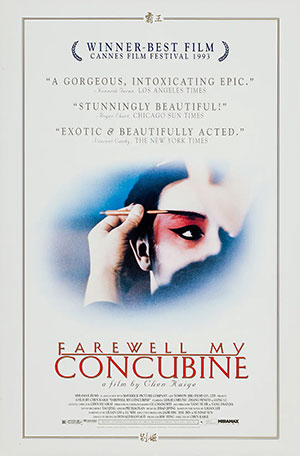

Farewell My Concubine (1993)

Drama/Music/History
Profile by John Doe
★9.6
Recommendation 128.8K
Farewell My Concubine

Release Date: 1

Director: Chen Kaige

Cast: Leslie Cheung, Zhang Fengyi, Gong Li, Ge You

Production: Beijing Film Studio, China Film Co-Production Corporation, Tomson Film Entertainment Ltd.

Synopsis of the Farewell My Concubine

The wail of a child cuts through the bustle of a Beijing alley. Young Douzi is dragged by his mother to the Peking Opera troupe, his bound feet bleeding, his fate sealed with a single slash of scissors—cutting off his connection to the mundane world, forcing him into the harsh discipline of opera training. There, he meets Shitou, a tough yet protective boy, and the two form a bond forged in sweat, tears, and the pain of broken bones. Years pass, Douzi grows into Cheng Dieyi, embodying the female role of Concubine Yu with a haunting, otherworldly grace; Shitou becomes Duan Xiaolou, the heroic General Xiang Yu. Their duet in "Farewell My Concubine" becomes legendary, a perfect fusion of art and soul that captivates audiences across Beijing. But as the world changes—from the turmoil of warlords to the Japanese occupation, from the founding of New China to the Cultural Revolution—their friendship and art are torn apart. Xiaolou marries Juxian, a former prostitute with a fiery spirit, and Dieyi’s world crumbles: his dedication to opera is absolute, his feelings for Xiaolou transcend stage and reality, but Xiaolou chooses the ordinary life of a husband and father. Political storms lash out, forcing them to betray each other, to denounce their art, to watch as Juxian’s spirit is crushed. Decades later, in a time of peace, the two reunite on stage for one last performance of "Farewell My Concubine". This time, Dieyi, the eternal Concubine Yu, doesn’t just act the part—he lives it, ending his life with the same sword as his character, merging art and life into a final, tragic masterpiece.

Detailed Review & Analysis

Farewell My Concubine isn’t just a film about Peking Opera—it’s an epic tragedy spanning half a century, a profound meditation on the cost of art, the fragility of human connection, and the inescapable grip of fate. Unlike Inception’s crisp, puzzle-like structure and kinetic energy, Chen Kaige’s masterpiece unfolds like a scroll painting, slow, lyrical, and overflowing with raw emotion, every frame steeped in the dust and grandeur of history. Have you ever loved something so deeply that it becomes your entire identity? Have you watched the world change around you, leaving you adrift in a time that no longer understands you? Dieyi’s story answers these questions with a poignancy that lingers like the echo of an opera aria. The sensory details are rich and immersive: the sharp sting of the scissors on Dieyi’s finger, the grit of sawdust on the troupe’s floor, the shimmer of silk costumes under stage lights, the harsh shouts of Red Guards cutting through the silence, the trembling of Dieyi’s voice as he sings of Concubine Yu’s despair. The film’s greatest strength is its seamless integration of personal fate and historical upheaval—Dieyi, Xiaolou, and Juxian aren’t just characters; they’re casualties and survivors of a changing nation, their joys and sorrows mirroring the triumphs and tragedies of an era. Yet it’s not without flaws: some historical transitions feel abrupt, and the secondary characters are often overshadowed by the three leads, lacking depth. Compared to Inception’s focus on the internal labyrinth of the mind, Farewell My Concubine’s scope is broader, exploring the external forces that shape and destroy us. What makes the film unforgettable is Dieyi’s unwavering dedication to his art and his love—a purity that’s both admirable and tragic. When he falls on his sword at the end, it’s not just a death; it’s a surrender to the only truth he knows: that art is more real than life, that love is more enduring than time. Farewell My Concubine is a masterpiece of Chinese cinema, a film that demands to be felt as much as watched. It reminds us that great art doesn’t just reflect life—it transcends it, and that the deepest tragedies are those where we cannot separate ourselves from the roles we play, the loves we hold, and the art that defines us.

Write a Comment (0)

0/200
☆ ☆ ☆ ☆ ☆
0/10

No comments yet. Be the first to comment!