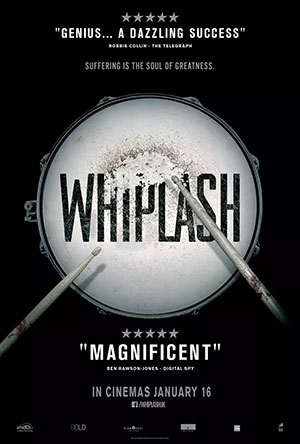


Whiplash (2014)

Drama/Music
Profile by John Doe
★8.5
Recommendation 87.7K
Whiplash

Release Date: 20141010

Director: Damien Chazelle

Cast: Miles Teller, J.K. Simmons, Paul Reiser, Melissa Benoist

Production: Sony Pictures Classics, Bold Films

Synopsis of the Whiplash

Andrew Neiman, a young, ambitious jazz drummer at the prestigious Shaffer Conservatory of Music, harbors an unyielding desire to become one of the all-time greats—someone remembered like his idol, Charlie Parker. His life takes a turbulent turn when he is selected by Terence Fletcher, the conservatory’s infamous and ruthless studio band conductor, known for his brutal teaching methods and relentless pursuit of perfection. Fletcher’s mentorship is a relentless onslaught of verbal abuse, public humiliation, and psychological manipulation, all designed to push his students beyond their breaking points. What begins as Andrew’s dream opportunity quickly devolves into a grueling battle of wills: Fletcher sees Andrew’s raw talent and seeks to forge it into brilliance through pain, while Andrew becomes obsessed with proving himself worthy, sacrificing his relationships, his mental health, and even his physical well-being in the process. As the pressure mounts, their toxic dynamic spirals out of control, leading to a catastrophic falling-out. But when fate forces them to confront each other again on the biggest stage of Andrew’s career, the pair engages in a high-stakes musical showdown that will define whether Andrew’s ambition leads to glory or destruction.

Detailed Review & Analysis

Whiplash is far more than a film about music; it’s a searing exploration of the intoxicating and destructive nature of ambition, and the dangerous myth that greatness can only be forged through suffering. Unlike conventional underdog narratives that celebrate perseverance as an unalloyed virtue, this film peels back the curtain on the cost of chasing excellence at all costs, exposing how the line between dedication and self-erasure can vanish in the heat of obsession. What sets it apart is its refusal to romanticize the 'tough love' mentor trope; Fletcher is not a well-meaning perfectionist, but a manipulative tyrant who weaponizes fear to exert control, while Andrew’s ambition is not a noble drive, but a compulsive need to validate his existence through achievement. Unlike works that frame success as a redemptive endpoint, the film presents greatness as a double-edged sword—one that cuts through mediocrity but also severs the connections that make life meaningful. The film’s power lies in its visceral intensity: the thunderous rhythm of the drum solos, the crackle of Fletcher’s verbal attacks, and the quiet moments of Andrew’s isolation, all combining to immerse the audience in the suffocating pressure of his world. What makes it unforgettable is its ambiguous moral core; it doesn’t condemn or glorify Andrew and Fletcher’s dynamic, but forces viewers to confront the uncomfortable question of what we’re willing to sacrifice for our dreams. Long after the credits roll, what lingers isn’t just the electrifying final performance, but the haunting realization that ambition can become a prison—that the very drive that propels us forward can also consume us, leaving us with nothing but the hollow echo of the perfection we chased. It’s a film that challenges the myth of 'no pain, no gain', asking whether the price of greatness is ever truly worth paying.

Write a Comment (0)

0/200
☆ ☆ ☆ ☆ ☆
0/10

No comments yet. Be the first to comment!