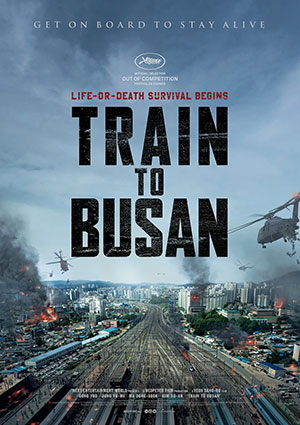

Train to Busan (2016)

Horror / Thriller
Profile by John Doe
★8.7
Recommendation 31.6K
Train to Busan

Release Date: 20160720

Director: Yeon Sang-ho

Cast: Gong Yoo, Jung Yu-mi, Ma Dong-seok, Kim Su-an

Production: Next Entertainment World, Red Peter Films

Synopsis of the Train to Busan

The KTX train bound for Busan departs from Seoul Station at dawn, carrying a diverse group of passengers: Seok-woo, a workaholic fund manager estranged from his young daughter Su-an; Sang-hwa, a tough yet gentle man traveling with his pregnant wife Seong-kyeong; a group of high school students led by the athletic Yong-guk and his girlfriend Min-jeong; an elderly sister pair; and a selfish corporate executive. What starts as a routine journey takes a terrifying turn when a disheveled woman stumbles onto the train, her body twitching uncontrollably. Within minutes, she attacks a crew member, and a zombie virus spreads like wildfire through the carriages. Panic erupts as passengers realize they’re trapped on a speeding train with ravenous, fast-moving zombies. Seok-woo, initially only concerned with protecting himself and Su-an, is forced to team up with Sang-hwa and other survivors to fight their way through infected carriages. They climb over luggage racks, barricade doors with seats, and risk their lives to rescue others—all while the train hurtles toward Busan, said to be the only safe haven. But the real danger isn’t just the zombies; it’s the paranoia and selfishness of some survivors, who seal off carriages to protect themselves, abandoning those still fighting for their lives. As the train makes emergency stops at infected stations and the number of zombies grows, Seok-woo and the others must confront a brutal truth: in the face of extinction, humanity itself may be the biggest threat. Will they make it to Busan alive? And what will they lose along the way?

Detailed Review & Analysis

《Train to Busan》isn’t just a zombie horror film—it’s a gripping exploration of human nature under extreme pressure, using the confined space of a speeding train to amplify the tension between survival instinct and moral duty. Unlike the biographical introspection of《Amadeus》, the intimate character bonds of《Léon: The Professional》, or the social realism of《Dying to Survive》, this film thrives on relentless pacing, heart-pounding action, and nuanced group dynamics, blending bone-chilling horror with profound emotional resonance. Have you ever wondered how you’d act in a life-or-death situation? Would you prioritize your own safety, or risk everything to help others?《Train to Busan》forces these questions into sharp focus, using its ensemble cast to showcase the full spectrum of human behavior—from selfless heroism to cowardly betrayal. The sensory details are overwhelming in their intensity: the ear-splitting screams of infected passengers, the thud of zombies slamming against locked doors, the tightness in Seok-woo’s chest as he runs through smoke-filled carriages, the warmth of Su-an’s hand in his as they cling to each other, the silence that follows a devastating loss. The film’s greatest strength is its refusal to reduce characters to stereotypes: Seok-woo evolves from a selfish, distant father to a self-sacrificing hero; the corporate executive, while despicable, is a haunting reminder of how fear can corrupt even the most privileged; Sang-hwa and Seong-kyeong’s love and loyalty provide a beacon of hope amid the chaos. Yet it’s not without flaws: some zombie attack sequences rely on familiar horror tropes, and a few character decisions feel overly convenient for the plot. Compared to films that focus on individual journeys or grand themes,《Train to Busan》is a collective drama—each character’s choice impacts the group, and the train itself becomes a microcosm of society, where class, gender, and age differences collide in the fight for survival. When Seok-woo makes his final sacrifice, pushing Su-an and Seong-kyeong to safety before succumbing to infection, it’s a moment that transcends horror, revealing the film’s core truth: even in the darkest of times, love and selflessness can outshine fear. This film endures because it understands that horror isn’t just about jump scares and gore—it’s about the things that scare us most about ourselves. Long after the credits roll, you’ll find yourself remembering the sound of the train’s whistle cutting through the chaos, the sight of Su-an’s tearful face, and the realization that humanity’s greatest strength lies not in survival alone, but in the way we choose to protect each other.

Write a Comment (0)

0/200
☆ ☆ ☆ ☆ ☆
0/10

No comments yet. Be the first to comment!