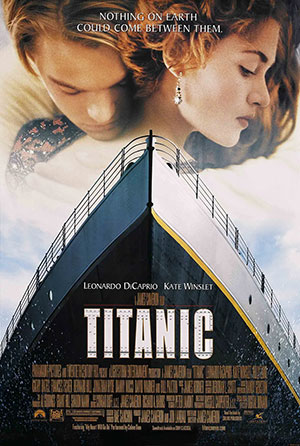


Titanic (1997)

Romance/Disaster/Drama
Profile by John Doe
★9.5
Recommendation 125.4K
Titanic

Release Date: 1

Director: James Cameron

Cast: Leonardo DiCaprio, Kate Winslet, Billy Zane, Kathy Bates

Production: 20th Century Fox Film Corporation, Paramount Pictures

Synopsis of the Titanic

rusted safe pulled from the wreckage of the Titanic triggers a flood of memories for 101-year-old Rose DeWitt Bukater. As researchers show her a sketch of a young woman wearing the "Heart of the Ocean" diamond, she begins to tell the story of a summer in 1912 that changed everything. Back then, she was a young aristocrat trapped in a gilded cage, engaged to the wealthy but cruel Cal Hockley to save her family from financial ruin. The Titanic, on its maiden voyage, was her prison—until she met Jack Dawson, a carefree artist who won his ticket in a poker game. Jack saw beyond her polished exterior, recognizing the loneliness and longing for freedom in her eyes. He taught her to dance in the third-class dormitories, to spit off the ship’s bow, and to embrace life without fear. Their forbidden romance bloomed secretly, away from the prying eyes of the upper class. But happiness was short-lived: the "unsinkable" ship struck an iceberg at midnight, and chaos erupted as the crew scrambled to launch lifeboats. Rose and Jack were torn apart by the disaster—he fought to keep her safe, while she refused to leave him behind. The once-glorious ship began to sink, its grand decks collapsing, its corridors flooding. As the icy Atlantic waters claimed the vessel and hundreds of lives, Rose clung to Jack, their love a tiny flame in the darkness. The memories fade as old Rose finishes her story, but the question lingers: how did she survive, and what became of the love that defied class and tragedy?

Detailed Review & Analysis

《Titanic》 isn’t just a love story set against a disaster—it’s a poignant meditation on time, memory, and the enduring power of love, told through a dual timeline that bridges the past and present. Unlike the previous sweeping romantic epic style, this film’s charm lies in the contrast between the fragility of human life and the permanence of true love, with old Rose’s trembling voice adding a layer of nostalgia and regret that makes the story feel more intimate and real. Have you ever had a memory so vivid that it feels like yesterday? Have you ever loved someone so deeply that their presence stays with you for a lifetime? Rose’s story answers these questions with a tenderness that tugs at the heartstrings. The sensory details are layered and evocative: the creak of the Titanic’s wooden decks under Jack and Rose’s feet, the warmth of the sun on their faces as they stand on the bow, the sharp crack of the iceberg against the hull, the numbing cold of the ocean that chills even through the screen, the quiet rasp of old Rose’s voice as she recalls her lost love. The film’s greatest strength is its use of the dual timeline—old Rose’s present-day narrative grounds the tragic romance in reality, reminding us that this isn’t just a fictional story, but a reflection of the countless lives lost in the disaster. The contrast between the opulence of the upper-class cabins and the gritty warmth of the third-class quarters also highlights the class divides of the era, making Jack and Rose’s love not just a romance, but an act of rebellion. Yet it’s not without flaws: the subplot involving the "Heart of the Ocean" diamond feels somewhat forced, and some of Cal’s villainous actions are overly dramatic. Compared to the grand, sweeping tone of the original romantic epic interpretation, this dual-timeline approach makes the film more introspective—focusing less on the spectacle of the disaster and more on the emotional impact it has on a single life. When old Rose drops the diamond into the ocean, letting it sink to the wreckage of the Titanic, it’s a symbolic gesture of letting go, but also a testament to the fact that true love doesn’t need material tokens to endure. The final scene, where Rose reunites with Jack on the Titanic’s grand staircase, surrounded by the other victims, is not just a fantasy—it’s a celebration of the idea that love transcends death. 《Titanic》 endures because it understands that the most powerful stories are the ones that mix joy and sorrow, love and loss, and remind us to cherish every moment we have. Long after the credits roll, you’ll find yourself thinking not just about the sinking ship, but about Rose and Jack’s promise to live, and the way love can make even the darkest tragedies feel meaningful.

Write a Comment (0)

0/200
☆ ☆ ☆ ☆ ☆
0/10

No comments yet. Be the first to comment!