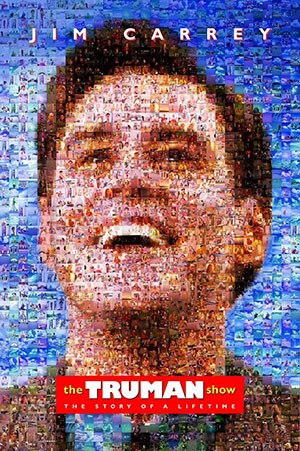

The Truman Show (1998)

Comedy/Drama/Sci-Fi
Profile by John Doe
★8.2
Recommendation 98.8K
The Truman Show

Release Date: 19980605

Director: Peter Weir

Cast: Jim Carrey, Ed Harris, Laura Linney, Noah Emmerich

Production: Paramount Pictures, Scott Rudin Productions

Synopsis of the The Truman Show

Truman Burbank lives a seemingly idyllic life in the picturesque town of Seahaven: he has a stable job as an insurance salesman, a friendly neighbor, and a wife who dotes on him. Little does he know, every moment of his existence is being broadcast live to millions of viewers around the world—he is the unwitting star of the longest-running reality TV show in history. Seahaven is a massive, custom-built set, and everyone in his life, from his parents to his colleagues, are actors following a pre-written script. As Truman grows older, he begins to notice subtle inconsistencies in his perfect world: a stage light falls from the sky, his wife randomly promotes products to the 'air', and a man who resembles his deceased father suddenly appears. These anomalies spark a growing sense of unease and curiosity, driving him to question the reality of his life. Determined to find the truth, Truman sets out to escape Seahaven, a quest that threatens to dismantle the entire show and the career of its manipulative creator, Christof. As the world watches, Truman must overcome his fears of the unknown and fight for his right to live a life of his own choosing, free from the constraints of being a spectacle.

Detailed Review & Analysis

The Truman Show is far more than a satirical comedy about media obsession; it's a profound existential exploration of identity, freedom, and the courage to break free from the invisible cages that define our lives. Unlike conventional narratives about self-discovery, this film uses the meta-concept of a 'scripted life' to challenge the audience's perception of reality—asking whether we, too, are trapped in routines, expectations, or societal norms that we mistake for free will. What sets it apart is its unflinching critique of the voyeuristic nature of modern media, which reduces human life to entertainment and prioritizes ratings over the dignity of the individual. Unlike works that frame rebellion as a loud, aggressive act, The Truman Show portrays courage as a quiet, unwavering determination: Truman's journey isn't about defeating a physical villain, but about confronting the comfort of the familiar and embracing the chaos of the unknown. The film's genius lies in its ability to balance humor and pathos; the absurdity of Truman's scripted interactions contrasts sharply with his genuine longing for truth and connection, making his struggle both relatable and deeply moving. What makes it unforgettable is its refusal to offer a simplistic happy ending; instead, it acknowledges that freedom comes with uncertainty—Truman's escape from Seahaven is not the end, but the beginning of a life he must build for himself. Long after the credits roll, what lingers isn't just the iconic image of Truman walking through the exit door, but the haunting question of how many of us are still 'Trumans'—going through the motions of life without questioning whether the world we live in is truly our own. It's a film that challenges us to awaken from our own complacency, to question the 'scripts' we follow, and to have the courage to chase the truth, no matter how terrifying or uncertain it may be.

Write a Comment (0)

0/200
☆ ☆ ☆ ☆ ☆
0/10

No comments yet. Be the first to comment!