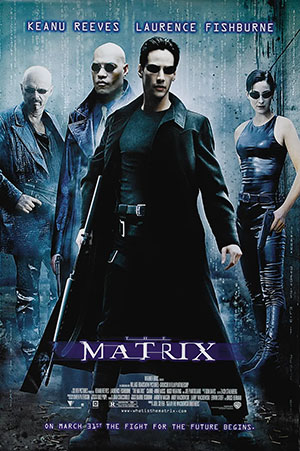


The Matrix (1999)

Action/Sci-Fi
Profile by John Doe
★8.7
Recommendation 179.0K
The Matrix

Release Date: 19990331

Director: Lana Wachowski, Lilly Wachowski

Cast: Keanu Reeves, Laurence Fishburne, Carrie-Anne Moss, Hugo Weaving

Production: Warner Bros. Pictures, Village Roadshow Pictures

Synopsis of the The Matrix

Thomas Anderson, a mild-mannered computer programmer by day and a rogue hacker named Neo by night, is haunted by a cryptic question: 'What is the Matrix?' His search for answers leads him to Morpheus, a mysterious rebel leader who claims to hold the truth about the world Neo inhabits. Morpheus offers Neo a choice—take the red pill to uncover reality, or the blue pill to return to his oblivious life. Choosing the red pill, Neo is jolted into a nightmare: the world he knows is a simulated reality called the Matrix, created by sentient machines to enslave humanity, who are kept in pods and harvested for their bioelectric energy. Awakened to the desolate post-apocalyptic truth, Neo joins Morpheus and his crew, including the fierce warrior Trinity, to fight against the machines. As Neo trains to master the Matrix—where physical laws can be bent and broken—he grapples with his destiny: Morpheus believes Neo is 'the One', a prophesied savior who will free humanity. But the machines, led by the cold, relentless Agent Smith, will stop at nothing to eliminate Neo and crush the rebellion, forcing him to confront whether he is truly the savior or just another pawn in a larger game.

Detailed Review & Analysis

The Matrix transcends the boundaries of cyberpunk sci-fi, evolving into a profound philosophical inquiry into the nature of reality, free will, and the cost of awakening to truth. Unlike conventional sci-fi films that prioritize action over ideas, this film weaves existential questions into every layer of its narrative, using the Matrix as a metaphor for the invisible systems—social, cultural, ideological—that shape and constrain our perception of the world. What sets it apart is its refusal to frame reality as a fixed truth; instead, it challenges viewers to question whether the 'real' is merely what we are conditioned to believe, and whether freedom lies in escaping illusion or embracing the power to redefine it. Unlike works that paint a binary struggle between humans and machines, the film blurs the line between oppressor and oppressed, hinting at a symbiotic tension where both sides are trapped in a cycle of control. The film’s genius lies in its fusion of high-octane action and abstract philosophy; the iconic bullet-time sequences and martial arts battles are not just spectacle, but visual representations of breaking free from programmed limitations. What makes it unforgettable is its exploration of choice as the ultimate act of rebellion: Neo’s decision to take the red pill is not just a plot point, but a metaphor for the courage to reject comfort and confront the unknown. Long after the credits roll, what lingers isn’t just the groundbreaking visuals, but the haunting question of how many of our own 'truths' are constructed, and whether we have the courage to challenge the matrices that define our lives. It’s a film that empowers viewers to see beyond the surface, reminding us that the greatest revolution begins with questioning the world we take for granted.

Write a Comment (0)

0/200
☆ ☆ ☆ ☆ ☆
0/10

No comments yet. Be the first to comment!