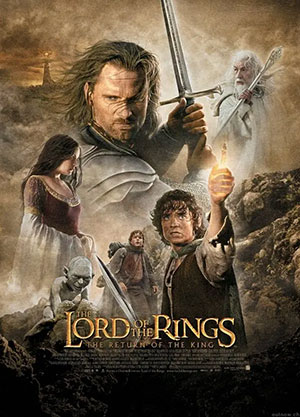

The Lord of the Rings: The Return of the King (2003)

Adventure/Drama/Fantasy
Profile by John Doe
★9.2
Recommendation 198.8K
The Lord of the Rings: The Return of the King

Release Date: 20031217

Director: Peter Jackson

Cast: Elijah Wood, Viggo Mortensen, Ian McKellen, Orlando Bloom

Production: New Line Cinema, WingNut Films

Synopsis of the The Lord of the Rings: The Return of the King

As the shadow of Sauron spreads across Middle-earth, the final chapter of the great quest to destroy the One Ring begins. Frodo Baggins, the weary hobbit bearing the Ring, continues his treacherous journey to Mount Doom with his loyal companion Samwise Gamgee, while the malevolent Gollum—consumed by his obsession with the 'precious'—plots to reclaim the Ring for himself, leading the pair deeper into danger. Meanwhile, Aragorn, the rightful heir to the throne of Gondor, finally embraces his destiny, rallying the free peoples of Middle-earth—humans, elves, dwarves, and hobbits—to stand against Sauron's overwhelming army of orcs at the gates of Minas Tirith. With the White City under siege and hope fading, Gandalf the Grey guides the defenders in their desperate resistance, while Legolas and Gimli fight alongside Aragorn in battles that will determine the fate of all. As the grand war rages on the fields of Pelennor, Frodo and Sam's private torment reaches its peak, their resolve tested by exhaustion, despair, and the Ring's corrupting influence. The fate of Middle-earth hangs in the balance: only if Frodo can cast the Ring into the fires of Mount Doom will Sauron's reign of darkness end, but the cost of victory may be more than any of them can bear.

Detailed Review & Analysis

The Lord of the Rings: The Return of the King transcends the boundaries of a fantasy epic, evolving into a profound meditation on the burden of destiny and the quiet, unyielding power of ordinary courage in the face of insurmountable evil. Unlike conventional final installments that rely solely on grand battle sequences to deliver closure, this film weaves two parallel narratives—the epic war for Middle-earth and the intimate, soul-crushing journey of Frodo and Sam—into a tapestry that explores both collective heroism and individual sacrifice. What sets it apart is its refusal to romanticize heroism as a trait reserved for kings or warriors; instead, it honors the quiet resilience of the 'small folk'—hobbits who carry the weight of the world not out of desire for glory, but out of love for their home and friends. Unlike works that frame victory as a triumphant, uncomplicated triumph, the film lays bare the cost of goodness: the scars of war, the loss of innocence, the lingering trauma of those who survive. It doesn't shy away from despair; instead, it shows how hope can persist even in the darkest moments, not as a grand ideal, but as a small, stubborn choice to keep going. What makes it unforgettable is its exploration of redemption and legacy: characters like Aragorn come to terms with their pasts to embrace their futures, while Frodo's journey reveals that some wounds never fully heal, and that survival itself is a form of courage. Long after the credits roll, what lingers isn't just the awe of the battle scenes or the beauty of Middle-earth, but the haunting realization that evil is not defeated by strength alone, but by the bonds of friendship, the willingness to sacrifice, and the quiet conviction that even the smallest individual can change the course of destiny. It's a film that celebrates the triumph of light over darkness, not as a fleeting victory, but as a testament to the enduring power of goodness in a world that is often cruel and uncertain.

Write a Comment (0)

0/200
☆ ☆ ☆ ☆ ☆
0/10

No comments yet. Be the first to comment!