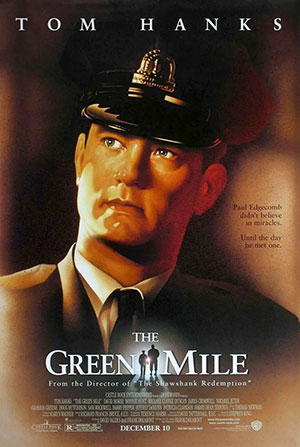

The Green Mile (1999)

Crime/Drama/Fantasy
Profile by John Doe
★8.6
Recommendation 123.5K
The Green Mile

Release Date: 19991210

Director: Frank Darabont

Cast: Tom Hanks, Michael Clarke Duncan, David Morse, Bonnie Hunt

Production: Warner Bros. Pictures, Castle Rock Entertainment

Synopsis of the The Green Mile

Set in 1935 Louisiana, the film unfolds through the memories of Paul Edgecomb, a elderly man reflecting on his time as a death row prison guard overseeing 'E Block'—a section of Cold Mountain Penitentiary nicknamed 'The Green Mile' for its lime-green linoleum floor leading to the electric chair. Plagued by a painful urinary tract infection, Paul’s life on the grim cell block takes an unexpected turn with the arrival of John Coffey, a towering, gentle-hearted Black man convicted of raping and murdering two young white girls. Despite his imposing physique and heinous charges, Coffey exhibits childlike innocence: he fears the dark, cries at the sight of suffering, and possesses an unexplained, supernatural ability to heal others. Paul, initially skeptical, witnesses Coffey cure his infection and even revive a dying mouse belonging to another inmate. As Paul and his fellow guards grow to care for Coffey, they begin to doubt his guilt, uncovering inconsistencies in the case that suggest he was wrongfully accused. Trapped between their duty to carry out the death sentence and their growing conviction that Coffey is a force of goodness, Paul and his team face an agonizing moral dilemma—one that forces them to confront the cruelty of the justice system and the fragility of human judgment.

Detailed Review & Analysis

The Green Mile transcends the boundaries of a prison drama, emerging as a poignant meditation on the fragility of goodness in a cruel world and the moral paradox of mercy within a system designed for punishment. Unlike conventional narratives that pit heroism against villainy, this film blurs the lines between innocence and guilt, power and vulnerability, framing John Coffey as a modern-day Christ figure trapped in a world that cannot comprehend his purity. What sets it apart is its refusal to sensationalize its supernatural elements; Coffey’s healing ability is not a plot device for triumph, but a source of profound suffering—forcing him to absorb the pain of others and bear the weight of humanity’s cruelty. Unlike works that reduce prison stories to tales of violence or redemption, the film’s power lies in its quiet intimacy: the tender moments between Paul and Coffey, the camaraderie among the guards, and the quiet despair of men awaiting execution, all rendered with profound empathy. It challenges the notion of absolute justice, revealing how prejudice, fear, and systemic bias can condemn the innocent and corrupt even the most well-meaning individuals. What makes it unforgettable is its exploration of grief and grace; Coffey’s supernatural gift is both a blessing and a curse, allowing him to ease suffering while making him acutely aware of the world’s darkness. Long after the credits roll, what lingers isn’t just the heart-wrenching tragedy of Coffey’s fate, but the haunting realization that goodness often exists in the unlikeliest places—and that the true 'punishment' may be for those who are forced to uphold a system that crushes the very humanity it claims to protect. It’s a film that reminds us that mercy is not a sign of weakness, but a testament to our shared humanity, and that some souls are too pure for a world stained by injustice.

Write a Comment (0)

0/200
☆ ☆ ☆ ☆ ☆
0/10

No comments yet. Be the first to comment!