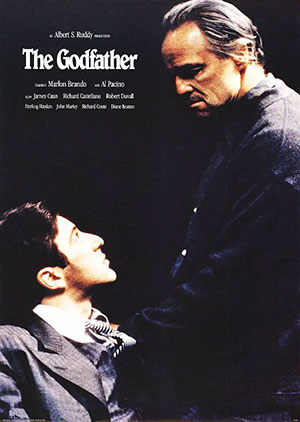

The Godfather (1972)

Drama/Crime
Profile by John Doe
★9.3
Recommendation 136.5K
The Godfather

Release Date: 1

Director: Francis Ford Coppola

Cast: Marlon Brando, Al Pacino, James Caan, Robert Duvall

Production: Paramount Pictures

Synopsis of the The Godfather

1945, New York. The wedding of Connie Corleone fills the garden of the Corleone estate with music and laughter, while inside, her father—Vito Corleone, the Godfather—sits behind a desk, granting favors to those who show him respect. Vito is the head of a powerful Mafia family, ruling over a shadowy empire of gambling, liquor, and protection rackets with quiet authority and unwavering loyalty to his kin. His youngest son, Michael, a decorated war hero, wants nothing to do with the family business, choosing a civilian life with his girlfriend Kay Adams. But fate intervenes when a rival gangster, Sollozzo, attempts to assassinate Vito and force the Corleones into the drug trade. With Vito hospitalized and his eldest son Sonny hot-headed and reckless, the family teeters on the brink of collapse. Michael, once the outsider, steps forward to avenge his father: he guns down Sollozzo and a corrupt police captain in a restaurant, then flees to Sicily. Time passes, Sonny is brutally murdered, and Vito, recovered but weakened, hands over the reins to Michael. Returning to New York, Michael abandons his old self, embracing the cold pragmatism of power. He orchestrates a sweeping purge of rival families and traitors, solidifying his position as the new Godfather. But the cost is steep: his marriage to Kay frays, his innocence is lost, and the line between family duty and moral corruption blurs beyond recognition. Can the Corleone family survive under Michael’s rule? Or will the darkness of power consume the very bonds that once held them together?

Detailed Review & Analysis

《The Godfather》 isn’t just a gangster film—it’s a magisterial epic of family, power, and the erosion of morality, a masterpiece that redefined the crime genre with its slow-burning tension and profound exploration of human nature. Unlike 《Titanic》’s dual-timeline nostalgia and romantic poignancy, this film unfolds with unflinching冷峻, using muted tones, deliberate pacing, and sparse dialogue to build a world where loyalty is currency and violence is a necessary evil. Have you ever wondered how far you’d go to protect your family? At what point does duty become betrayal of your own values? Michael Corleone’s journey forces these questions into sharp focus, making the film’s moral complexity impossible to ignore. The sensory details are subtle yet searing: the earthy aroma of olive oil and wine in the Corleone kitchen, the sharp crack of gunfire breaking the silence of a restaurant, the cold weight of Michael’s gaze as he makes his first kill, the quiet tension in the air during the family’s business meetings. The film’s greatest strength is its nuanced portrayal of the Corleone family—Vito isn’t a one-dimensional villain, but a patriarch driven by love for his family, his cruelty balanced by kindness; Michael isn’t a hero turned villain, but a man trapped by circumstance and legacy. Their relationship, and the shift of power between them, is the soul of the film. Yet it’s not without flaws: some supporting characters (like Michael’s first wife in Sicily) are underdeveloped, and the slow pacing may feel tedious to viewers accustomed to fast-paced crime thrillers. Compared to 《Titanic》’s focus on individual love amid tragedy, 《The Godfather》 is a study of collective family identity and the corrupting influence of power. When Michael closes the door on Kay, symbolically shutting her out of his criminal world and completing his transformation into the Godfather, it’s a devastating moment—proof that power comes at the cost of human connection. This film endures because it understands that the greatest conflicts aren’t between good and evil, but between the people we are and the people we’re forced to become. It’s a masterclass in storytelling, where every scene, every line of dialogue, serves to deepen the narrative and the characters. Long after the credits roll, you’ll find yourself thinking not just about the violence and the power struggles, but about the quiet tragedy of Michael Corleone—a man who lost himself to save his family. 《The Godfather》 isn’t just about the Mafia; it’s about the human condition, and the choices that define us.

Related Movies

Write a Comment (0)

0/200
☆ ☆ ☆ ☆ ☆
0/10

No comments yet. Be the first to comment!