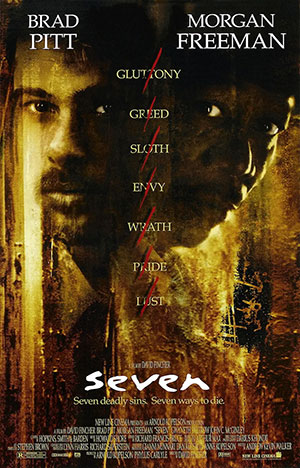


Se7en (1995)

Crime/Drama/Mystery
Profile by John Doe
★8.6
Recommendation 123.5K
Se7en

Release Date: 19950922

Director: David Fincher

Cast: Morgan Freeman, Brad Pitt, Kevin Spacey, Gwyneth Paltrow

Production: New Line Cinema, Cecchi Gori Pictures

Synopsis of the Se7en

In a rain-soaked, morally bankrupt city trapped in perpetual gloom, Detective William Somerset—an aging, world-weary investigator on the cusp of retirement—teams up with David Mills, a young, idealistic detective newly transferred to the precinct. Their partnership is tested from the start when they stumble upon a gruesome murder scene: a man forced to eat himself to death, a crime meticulously staged to represent 'Gluttony'—one of the Seven Deadly Sins. As the body count rises, each victim is killed in a manner symbolic of another sin, from a wealthy lawyer punished for 'Greed' to a man tortured for 'Sloth'. The killer, later revealed as John Doe, proves to be a calculating, philosophical madman who views his murders as a divine mission to expose the world’s moral rot. Somerset, haunted by years of witnessing humanity’s darkness, struggles to keep Mills’ fiery ambition in check, knowing the case will destroy the younger detective’s innocence. As they close in on Doe, the hunt becomes less about catching a criminal and more about surviving the psychological warfare waged by a killer determined to make them confront the ugliness at the heart of human nature.

Detailed Review & Analysis

Se7en is far more than a serial killer thriller; it’s a harrowing meditation on the inescapable presence of evil in modern society and the devastating cost of confronting it head-on. Unlike conventional crime films that frame justice as a redeeming force, this film plunges viewers into a world where morality is a faded illusion, and the line between hunter and hunted blurs under the weight of existential despair. What sets it apart is its refusal to offer catharsis; the killer’s plan isn’t just a series of murders, but a brutal social commentary that exposes the hypocrisy of a world that ignores its own moral decay until it’s staring them in the face. Unlike works that paint serial killers as deranged outliers, John Doe is presented as a warped product of the same society he condemns—his logic, though twisted, echoes the apathy and corruption surrounding the detectives. The film’s power lies in its oppressive atmosphere: the relentless rain, the grimy city streets, and the quiet tension between Somerset’s resignation and Mills’ naivety, all combining to create a sense of inescapable dread. What makes it unforgettable is its exploration of innocence lost; Mills’ descent from idealism to ruin isn’t just a plot twist, but a metaphor for how confronting unadulterated evil can strip away one’s faith in humanity. Long after the credits roll, what lingers isn’t just the shock of the film’s iconic climax, but the haunting realization that Doe’s message—however horrific its delivery—resonates because it speaks to a universal truth: evil isn’t an aberration, but a persistent, insidious part of the human condition. It’s a film that doesn’t just entertain; it challenges viewers to look away from the darkness, or to acknowledge that some horrors can never be erased.

Write a Comment (0)

0/200
☆ ☆ ☆ ☆ ☆
0/10

No comments yet. Be the first to comment!