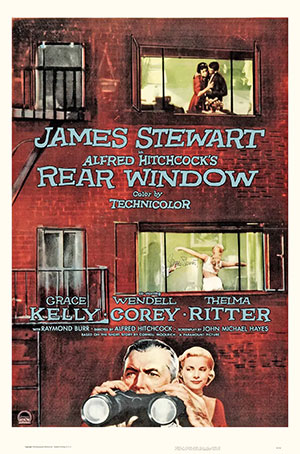


Rear Window (1954)

Mystery/Thriller
Profile by John Doe
★8.5
Recommendation 43.2K
Rear Window

Release Date: 19540801

Director: Alfred Hitchcock

Cast: James Stewart, Grace Kelly, Wendell Corey, Thelma Ritter

Production: Paramount Pictures

Synopsis of the Rear Window

Confined to a wheelchair by a broken leg sustained on a risky photojournalism assignment, L.B. Jeffries finds his world shrunk to the four walls of his Manhattan apartment. With nothing but time on his hands, he turns his binoculars to the rear window, a portal into the private lives of his neighbors. What begins as a desperate attempt to ward off boredom evolves into an intense fixation: he observes the bickering newlyweds, the eccentric sculptress who calls herself 'Miss Lonelyhearts', the aspiring composer burning the midnight oil, and Lars Thorwald, a taciturn traveling salesman caring for his bedridden wife. When Thorwald's wife vanishes without a trace, followed by his unusual late-night activities—dragging a heavy trunk to his car and scrubbing his apartment walls obsessively—Jeffries becomes convinced that a heinous crime has occurred. Dismissed as a bored voyeur by his sophisticated girlfriend Lisa Fremont and his no-nonsense nurse Stella, Jeffries refuses to back down. He leverages his photojournalistic skills, using his camera as a tool to uncover clues from his helpless vantage point. As his investigation deepens, the line between observer and target blurs, and the safety of his confined space is shattered, turning his quiet vigil into a deadly confrontation with a man who will stop at nothing to protect his secret.

Detailed Review & Analysis

Rear Window transcends the boundaries of a typical suspense thriller, emerging as a profound exploration of the anxiety inherent in passivity and the way isolation warps human perception. Unlike conventional mystery narratives that thrive on active investigation and physical pursuit, this film traps both the protagonist and the audience in a state of helpless observation, amplifying the tension through the agony of being unable to act directly. What distinguishes it is its acute focus on the psychological toll of confinement: Jeffries' increasing paranoia isn't just fueled by the suspicious events next door, but by his own powerlessness, which twists his curiosity into a compulsive need to control the narrative through observation. The film doesn't merely critique voyeurism; it delves into the human fear of being disconnected from the world, revealing how isolation can turn casual watching into a desperate grasp for connection. Unlike works that rely on explicit violence or sudden twists to create suspense, Rear Window's terror stems from the unknowns lurking in the shadows of ordinary lives and the uncertainty of Jeffries' own judgments—we, like him, are forced to question whether what we're seeing is the truth or a product of a bored, isolated mind. What makes it unforgettable is its exploration of the illusion of safety in observation: Jeffries believes he is safe behind his window, but the film dismantles this illusion, showing that watching others inevitably draws attention to oneself. Long after the credits roll, what lingers is not just the thrill of the mystery's resolution, but the unsettling realization that isolation can turn even the most rational mind into a prisoner of its own perceptions, and that the comfort of being an observer is often a fragile facade masking our deepest fears of powerlessness and disconnection.

Write a Comment (0)

0/200
☆ ☆ ☆ ☆ ☆
0/10

No comments yet. Be the first to comment!