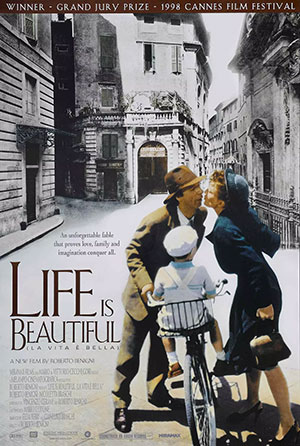

Life Is Beautiful (1997)

Comedy/Drama/Romance
Profile by John Doe
★8.6
Recommendation 76.5K
Life Is Beautiful

Release Date: 19971220

Director: Roberto Benigni

Cast: Roberto Benigni, Nicoletta Braschi, Giorgio Cantarini, Giustino Durano

Production: Miramax Films, Melampo Cinematografica

Synopsis of the Life Is Beautiful

In 1930s Italy, Guido Orefice, a charming, quick-witted Jewish waiter with a vivid imagination, falls hopelessly in love with Dora, a young schoolteacher from a wealthy family. Through a series of whimsical, romantic gestures—disguising himself as a school inspector, sweeping her off her feet on a bicycle—Guido wins Dora’s heart, and the two build a happy life together with their young son, Giosué. Their idyllic world shatters when World War II escalates: Guido and Giosué are arrested by Nazi soldiers and sent to a concentration camp, while Dora, though not Jewish, insists on accompanying them, refusing to be separated from her family. Faced with the unspeakable horrors of the camp, Guido concocts an elaborate lie to protect Giosué’s innocence: he frames their imprisonment as a grand game, where the goal is to earn 1,000 points by following rules and avoiding the guards. The winner, he promises, will receive a tank as a prize. Guido uses his humor, creativity, and unwavering love to keep the charade alive, shielding Giosué from the camp’s brutality while struggling to survive the daily atrocities around them. As the war nears its end and the camp descends into chaos, Guido fights to ensure his son’s safety, clinging to the lie that has become their only lifeline.

Detailed Review & Analysis

Life Is Beautiful is far more than a tragic romance or a Holocaust drama—it’s a profound meditation on the transformative power of love and storytelling, and how hope can survive even in the darkest corners of human cruelty. Unlike conventional Holocaust narratives that lean into unflinching despair, this film balances heart-wrenching tragedy with gentle whimsy, using Guido’s lie not as an act of denial, but as a radical act of love and resistance. What sets it apart is its refusal to reduce suffering to mere bleakness; instead, it explores how ordinary people can wield imagination as a shield, turning horror into a story their child can bear. Unlike works that frame paternal love as heroic grand gestures, the film’s power lies in its quiet, everyday sacrifices: Guido’s playful mimicry of German guards to make Giosué laugh, his whispered reassurances in the middle of the night, his unwavering commitment to preserving his son’s innocence at the cost of his own peace. The film doesn’t trivialize the Holocaust; rather, it uses Guido’s perspective to highlight the resilience of the human spirit, showing that love and humor are not weaknesses, but acts of defiance against oppression. What makes it unforgettable is its exploration of truth and illusion: Guido’s lie is an act of profound honesty, as it reveals the deepest truth of parenthood—to protect those we love from pain, even when we can’t protect ourselves. Long after the credits roll, what lingers isn’t just the tragedy of Guido’s fate, but the haunting beauty of his sacrifice: he turned a living nightmare into a story of hope, proving that even in the face of inevitable death, love can outlast cruelty, and a father’s devotion can make life beautiful, if only for a little while. It’s a film that challenges us to see the light in darkness, reminding us that storytelling is not just a form of escape, but a way to honor the ones we love.

Write a Comment (0)

0/200
☆ ☆ ☆ ☆ ☆
0/10

No comments yet. Be the first to comment!