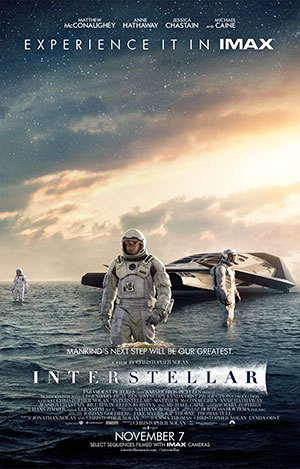


Interstellar (2014)

Sci-Fi/Adventure/Drama
Profile by John Doe
★9.4
Recommendation 152.4K
Interstellar

Release Date: 1

Director: Christopher Nolan

Cast: Matthew McConaughey, Anne Hathaway, Jessica Chastain, Mackenzie Foy

Production: Paramount Pictures, Warner Bros. Pictures, Legendary Pictures

Synopsis of the Interstellar

Dust storms rage across the American Midwest, coating farmhouses, crops, and hope in a gray haze. This is Earth’s last gasp—crops are failing one by one, famine looms, and the sky no longer holds wonder, only despair. Cooper, a former NASA pilot turned farmer, stares at the parched soil, his hands calloused from toil but his eyes still hungry for the stars. His daughter Murph, a sharp-witted girl with a knack for uncovering secrets, claims her bedroom is haunted by a "ghost"—dust patterns that spell out coordinates in binary code. Curiosity drives them to the coordinates, and there, hidden in the wilderness, is the last outpost of NASA. The mission? Slip through a wormhole near Saturn, traverse galaxies, and find a habitable planet for humanity’s survival. Leaving Murph—who feels betrayed by his departure—Cooper boards the Endurance spacecraft with a team of scientists: the steady Romilly, the pragmatic Doyle, and Amelia Brand, whose heart is tied to a distant planet and a lost lover. What awaits them beyond the wormhole? Planets where an hour equals seven Earth years, tidal waves taller than mountains, black holes that warp time and space, and the cold, infinite silence of the cosmos. Every step forward tears them further from home, every decision carries the weight of billions of lives, and as time bends around them, Cooper watches his children grow into adults through grainy video messages, his own life frozen in their past.

Detailed Review & Analysis

Interstellar isn’t just a sci-fi spectacle—it’s a raw, emotional odyssey that stretches across the stars and pierces the core of what it means to love. Unlike the claustrophobic tension of prison dramas or the quiet warmth of earthly biographies, Nolan’s film uses the vastness of the universe to magnify the intimacy of human connection. Have you ever wondered how far love can reach? Can it transcend time? Cross the gap between galaxies? Watching Interstellar, you’ll find yourself grappling with these questions as you’re sucked into its cosmic embrace. The sensory overload is intentional: the rumble of the Endurance’s engines vibrates in your chest, the eerie silence of space presses against your ears, the swirling colors of the wormhole dazzle your eyes, and the bone-chilling cold of alien planets makes you shiver. But what lingers long after the visual feast is the ache of separation—Cooper watching his daughter age decades in minutes, Murph clinging to the watch he left behind, their love stretched thin by time but never broken. The film’s greatest strength is its balance of hard sci-fi and heartfelt emotion: it doesn’t shy away from complex concepts like relativity or black holes, but it grounds them in human stakes. Yet it’s not without flaws: some expository dialogue feels clunky, and the third act’s reliance on a "love as a cosmic force" twist leans into sentimentality that clashes with the film’s scientific rigor. Compared to The Shawshank Redemption’s focus on individual redemption, Interstellar’s scope is grander—it’s about humanity’s collective redemption, about choosing to reach for the stars even when the world is crumbling beneath our feet. When Cooper finally tumbles through the tesseract, a mind-bending construct of time as a physical dimension, and sends the crucial data to Murph through the very dust patterns that started his journey, you’ll feel a surge of awe and sadness. This isn’t just a story about space travel; it’s a story about legacy, about the bonds that tie us to the past and the future. The final shot—Cooper setting off to find Amelia, the stars still calling—reminds us that curiosity and love are the only constants in an ever-expanding universe. Interstellar doesn’t just entertain; it makes you look up at the night sky again, not with fear, but with wonder, and whisper: "We were meant to be more than farmers.

Write a Comment (0)

0/200
☆ ☆ ☆ ☆ ☆
0/10

No comments yet. Be the first to comment!