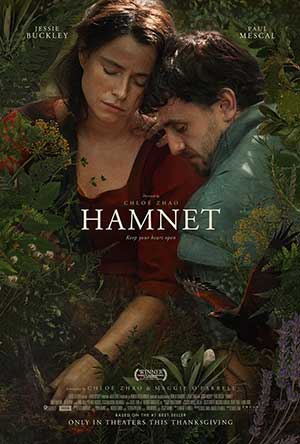


Hamnet (2025)

Drama/History/Biography
Profile by John Doe
★8.6
Recommendation 140.0K
Hamnet

Release Date: 2025-08-29(Telluride Film Festival) / 2025-09-07(Toronto Film Festival) / 2025-11-27(United States Limited Release) / 2025-12-12(United States)

Director: Unknown

Cast:

Production:

Synopsis of the Hamnet

Directed by Chloé Zhao and co-written by Zhao and Maggie O'Farrell, this poignant 125-minute drama, romance, and historical piece—co-produced by the United Kingdom and the United States, with Steven Spielberg and Sam Mendes serving as producers—brings to life the untold, heart-wrenching story behind one of literature’s greatest tragedies. Adapted from O'Farrell’s acclaimed 2020 bestselling novel, the film eschews grand depictions of William Shakespeare’s literary fame, instead turning its focus to the quiet, profound love between Shakespeare and his wife Agnes, and the devastating loss of their young son Hamnet to the plague. Filmed in English and premiering at the Telluride Film Festival on August 29, 2025, followed by screenings at the Toronto Film Festival, a U.S. limited release on November 27, and a wide U.S. release on December 12, it stars Jessie Buckley, Paul Mescal, Emily Watson, Joe Alwyn, and Jacobi Jupe in deeply resonant performances. Zhao’s signature restrained direction, characterized by sweeping long shots and a profound connection to nature, weaves together moments of tender domestic joy—Agnes giving birth in a sun-dappled forest, the playful chaos of raising twins—and crippling grief, exploring how loss shapes love, identity, and art. It is not merely a story about Shakespeare; it is a meditation on motherhood, absence, and the quiet resilience of a woman who navigates life’s greatest sorrows, while her husband channels his pain into the timeless tragedy of Hamlet, a testament to a son lost but never forgotten.

Detailed Review & Analysis

Hamnet unfolds like a half-remembered lullaby—soft, sorrowful, and steeped in a quiet humanity that feels nothing like the grand historical dramas I’m used to. I braced for a narrative centered on Shakespeare’s literary legacy, a tale of genius forged in grief, but Chloé Zhao offers something far more delicate: a portrait of love and loss rooted in the small, unremarkable moments that make a family. This film doesn’t demand attention with dramatic flourishes; it settles over you like the soft rain that dots its scenes, letting emotion sink in slowly, without hurry. Jessie Buckley’s Agnes is a revelation—not a polished “mother figure,” but a woman of quiet fire and fragile warmth, who carries her love for Hamnet in every gesture: the way she brushes his hair, the hesitation in her voice when she fears for his health, the quiet defiance with which she refuses to let his memory fade. Her performance is stripped of pretense, so authentic that it feels less like acting and more like bearing witness; there are moments when her grief is so tangible, you can almost reach out and touch it, a heavy, tender weight. Paul Mescal redefines Shakespeare, too—he’s not the mythic wordsmith of legend, but a flawed, distant man, torn between the pull of his craft and the love of his family, haunted by the knowledge that his ambition kept him from the son who needed him most. He avoids the tired “tortured artist” clichés, instead leaning into vulnerability, showing a man who doesn’t know how to grieve, who turns to words because they’re the only thing he can control. Zhao’s direction elevates every moment—her long, lingering shots of sun-dappled forests and quiet hearths, her use of nature as a mirror for the family’s emotions, the way silence speaks louder than any dialogue. This isn’t a film about Hamlet, the play; it’s about Hamnet, the boy—his laughter, his curiosity, the way he loved his mother, and the hole his loss left in a family that could never be the same. Leaving the theater, I felt a quiet ache, not of despair, but of recognition—the kind of grief that comes from loving deeply, from knowing that loss is a part of love. Zhao doesn’t romanticize sorrow; she honors it, letting it exist in all its messiness and beauty, reminding us that love isn’t erased by death—it lingers in the small things: a shared memory, a familiar song, a line of poetry written in a moment of pain. Weeks later, I still find myself thinking of Agnes, sitting in her garden, talking to a son who isn’t there, and of Shakespeare, pen in hand, turning his heartbreak into something that would outlive them both. That’s the power of Hamnet: it doesn’t just tell a story—it becomes a memory, one you carry with you long after the screen goes dark.

Write a Comment (0)

0/200
☆ ☆ ☆ ☆ ☆
0/10

No comments yet. Be the first to comment!