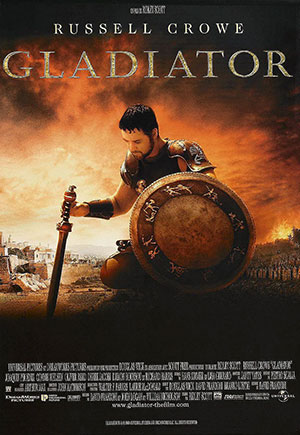


Gladiator (2000)

Action/Adventure/Drama
Profile by John Doe
★8.5
Recommendation 145.7K
Gladiator

Release Date: 20000505

Director: Ridley Scott

Cast: Russell Crowe, Joaquin Phoenix, Connie Nielsen, Oliver Reed

Production: Universal Pictures, DreamWorks Pictures

Synopsis of the Gladiator

At the height of the Roman Empire, General Maximus Decimus Meridius is the most trusted ally of Emperor Marcus Aurelius, who sees in him the ideal successor to safeguard the republic. But the emperor's jealous son, Commodus, learns of his father's plan and murders him in cold blood, seizing the throne. Commodus orders the execution of Maximus and his family, but the general narrowly escapes death, only to be captured by slave traders and sold into gladiatorial combat. Stripped of his rank, his family slaughtered, and his identity erased, Maximus becomes a gladiator, fighting for his life in the blood-soaked arenas of Rome. His unmatched skill and quiet dignity earn him the adoration of the crowds, turning him into a symbol of resistance against Commodus' tyrannical rule. As Maximus climbs the ranks of the gladiatorial world, he bides his time, driven by a burning desire for revenge and a vow to fulfill Marcus Aurelius' last wish of restoring the republic. When he finally faces Commodus in the Colosseum, the fate of Rome—and Maximus' own redemption—hangs in the balance, as the gladiator must choose between vengeance and the greater good of the empire.

Detailed Review & Analysis

Gladiator isn't merely a grand historical epic—it's a visceral meditation on loss, identity, and the cost of honor in a world ruled by greed and tyranny, using the spectacle of Roman gladiatorial combat to frame a deeply personal journey of grief and redemption. What sets it apart from conventional historical dramas is its refusal to reduce its characters to heroic archetypes; instead, it lays bare the fragility of human resolve, showing how even the strongest souls can be broken by loss, yet rise again through the power of purpose. Unlike previous works that lean on systemic critique or character collisions, this film anchors its emotional core in Maximus' internal struggle: his longing for the quiet life he lost on his Spanish farm, his rage at Commodus' treachery, and his gradual realization that his revenge is tied to the fate of an entire empire. The film's spectacle—from the sweeping battlefields of Germania to the thunderous Colosseum—isn't just visual grandeur; it's a contrast to Maximus' inner world, highlighting the gulf between the empire's glory and the emptiness of its power. What makes it unforgettable is its exploration of honor as both a curse and a salvation: Maximus' unwavering commitment to his values keeps him alive in the arena, but also prevents him from escaping his past. Unlike films that offer triumphant, clear-cut endings, Gladiator embraces tragedy, reminding viewers that true redemption often comes at the cost of one's life. The film doesn't romanticize war or violence; instead, it exposes the horror of the arena, where men are turned into entertainment for the masses, and the corruption of power that turns a great empire into a playground for a tyrant. What lingers after the credits isn't the thrill of battle, but the image of Maximus, dying in the Colosseum, envisioning his family waiting for him in the afterlife—a reminder that even in the darkest of circumstances, the human spirit's longing for home and honor endures. It's a film that transcends its historical setting, speaking to the universal struggle to hold onto one's identity and values in the face of overwhelming adversity.

Write a Comment (0)

0/200
☆ ☆ ☆ ☆ ☆
0/10

No comments yet. Be the first to comment!