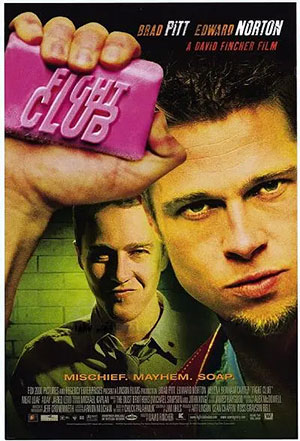


Fight Club (1999)

Drama/Thriller
Profile by John Doe
★8.8
Recommendation 145.7K
Fight Club

Release Date: 19991015

Director: David Fincher

Cast: Brad Pitt, Edward Norton, Helena Bonham Carter, Meat Loaf

Production: 20th Century Fox, Regency Enterprises

Synopsis of the Fight Club

A nameless narrator, a disillusioned corporate drone trapped in a cycle of mindless consumerism and chronic insomnia, finds no solace in the empty materialism that defines his life. His existence is upended when he crosses paths with Tyler Durden, a charismatic, anarchic soap salesman who rejects societal norms and embodies everything the narrator aspires to be. Fed up with their unfulfilling lives, the two men form Fight Club—a secret underground gathering where men bare-knuckle brawl in dimly lit basements, finding catharsis and a sense of purpose in physical pain and camaraderie. What begins as a rebellion against consumerist culture quickly spirals out of control, as Tyler transforms Fight Club into Project Mayhem, a radical movement dedicated to dismantling modern civilization through acts of sabotage. As the narrator becomes increasingly alienated from Tyler's extreme methods, he struggles to reclaim control, only to uncover a terrifying truth: Tyler is not a separate person, but a dissociative identity born from his own repressed anger and desire for rebellion. Trapped in a battle against himself, the narrator must confront the chaos he helped unleash and decide whether to embrace Tyler's destructive ideology or fight to save the world he once hated.

Detailed Review & Analysis

《Fight Club》is far more than a gritty thriller about underground brawling—it's a provocative, unflinching deconstruction of modern societal alienation, consumerism, and the fragile boundaries of identity, using visceral imagery and dark humor to challenge the very fabric of conventional life. Have you ever felt trapped by societal expectations, questioning whether the life you're living is truly your own? The narrator's journey resonates with this universal sense of disillusionment, laying bare the emptiness of a life defined by possessions rather than passion. The sensory details are visceral and unsettling: the cold, sterile glow of the narrator's IKEA-furnished apartment, the thud of fists against flesh in Fight Club's basements, the acrid smell of soap and gunpowder that lingers around Tyler, the panic in the narrator's voice as he realizes he's losing control, the eerie calm of Tyler's monologues that justify chaos as liberation. What sets this film apart is its unapologetic exploration of duality—both within the narrator's psyche and in society itself: the contrast between the narrator's repressed conformity and Tyler's unbridled anarchy mirrors the conflict between societal order and individual rebellion. Unlike stories that offer easy answers, 《Fight Club》embraces ambiguity, forcing viewers to confront uncomfortable truths about the cost of conformity and the danger of unchecked rebellion. The film also dismantles the myth of masculinity, showing how societal pressures to be 'strong' and 'successful' leave men disconnected from their emotions, turning to violence as a last resort for connection. If there's a shortcoming, it's that its radical message can feel overly nihilistic to some viewers, but this is integral to its critique of a disillusioned generation. What makes this film unforgettable is its refusal to compromise—its willingness to challenge viewers to reject the status quo and question everything, even as it warns of the pitfalls of blind rebellion. Long after the credits roll, you'll remember the narrator's iconic line 'The first rule of Fight Club is you do not talk about Fight Club', a metaphor for the secret longing many feel to break free from societal chains. It's a film that doesn't just entertain, but provokes—forcing reflection on what it means to be truly alive in a world that often feels designed to make us feel dead inside.

Related Movies

Write a Comment (0)

0/200
☆ ☆ ☆ ☆ ☆
0/10

No comments yet. Be the first to comment!