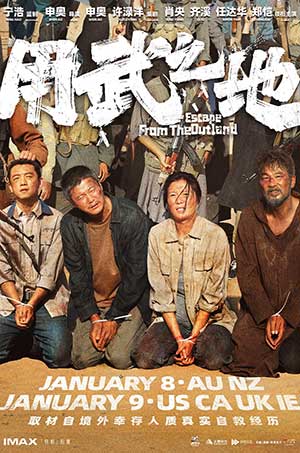

Escape From The Outland (2025)

Drama/Action/War
Profile by John Doe
7.6
Recommendation 0.0K
Coming Soon
Escape From The Outland

Release Date: 2025-12-31(China Mainland)

Director: Shen Ao

Cast: Xiao Yang, Qi Xi, Simon Yam, Zheng Kai, Pan Binlong, Fathi Anouar Ghammam

Production: China Film Group Corporation, Huayi Brothers Media Corporation, Shanghai Film Group

Synopsis of the Escape From The Outland

Marketedinternationally as Escape from the Outland (Chinese title: Yong Wu Zhi Di, or Where Might Is Put to Use), this harrowing war-zone survival drama is rooted in real-life incidents of Chinese citizens trapped in conflict-ridden regions overseas, offering a raw, unflinching look at human resilience in the face of unspeakable adversity. Directed by Shen Ao, a filmmaker known for his ability to blend intense emotion with uncompromising realism, and co-written by Shen Ao and Xu Luyang, the film eschews the glossy, heroic tropes of typical war dramas, instead diving into the gritty, unglamorous reality of captivity and survival. Set in a fictional but deeply plausible war-torn Middle Eastern country (echoing real-world conflicts that have endangered Chinese nationals abroad), the story centers on four strangers whose lives collide in the worst possible way: Ma Xiao (played by Xiao Yang), a seasoned Chinese foreign correspondent who traveled to the region to document the human cost of war, driven by a quiet determination to give voice to the voiceless; Pan Wenjia (Qi Xi), a compassionate volunteer doctor running a makeshift clinic for local civilians, her hands steady even as chaos erupts around her; Miao Feng (Zheng Kai), a pragmatic engineer overseeing a Chinese-funded infrastructure project, whose technical skills become a lifeline in captivity; and Li Weimin (Simon Yam), a shrewd businessman with a complicated past, whose connections and resourcefulness alternately divide and unite the group. Rounding out the cast is Pan Binlong in a pivotal supporting role as a fellow hostage, adding layers of vulnerability and dark humor to the tense narrative, alongside Fathi Anouar Ghammam as one of the militant captors, a nuanced portrayal that avoids one-dimensional villainy. The four are taken hostage by a ruthless militant group amid a sudden escalation of violence, their freedom stripped away as the militants tighten their grip, demanding ransom and using them as pawns in a larger political game. What follows is a grueling, months-long ordeal that charts the physical and psychological toll of captivity: crippling hunger that turns even a crust of bread into a luxury, dehumanizing humiliation that chips away at their dignity, and the constant, gnawing fear of death that hangs over every moment. Yet amid the despair, the film also captures small, quiet acts of defiance— a shared glance of solidarity, a whispered word of encouragement, a secret act of kindness—that remind them of their humanity. Shen Ao’s direction is masterful in its restraint; he keeps the camera tight to the characters’ faces, lingering on their bloodshot eyes, trembling hands, and frayed expressions, forcing the audience to feel every moment of their suffering. The film’s 131-minute runtime never feels excessive; instead, it allows the tension to build slowly, refusing to let the audience off easy, as the hostages grapple with betrayal, doubt, and the fragile hope of rescue. Shot on location in remote, rugged terrain that mirrors the chaos of a war zone, and featuring multilingual dialogue (blending Mandarin Chinese, English, French, and Arabic), Escape From The Outland is a powerful testament to the strength of the human spirit, a film that honors the courage of ordinary people thrust into extraordinary circumstances. It is not a story of heroic rescues or easy victories, but a grinding, unflinching chronicle of bodies and souls under pressure—one that asks difficult questions about survival, morality, and what it means to hold on to hope when all seems lost.

Detailed Review & Analysis

Escape From The Outland is not escapist entertainment—nor is it meant to be. It is a claustrophobic, emotionally searing survival drama that turns up the heat on human vulnerability, forcing the audience to confront the ugly, unvarnished reality of war and captivity. From the first frame to the last, the film refuses to sugarcoat the horror of its premise; it lives in the cramped, dimly lit room where the hostages are held, in the blindfolds that rob them of their sense of space, in the awful, endless stretch of days where hope is little more than a rumor, whispered in the dark to ward off despair. What strikes me most about this film is its commitment to realism—there are no superheroes here, no last-minute saves that feel cheap or unearned. Every performance stays grounded, raw, and unpolished, as the cast embodies the physical and psychological toll of captivity with haunting authenticity. Xiao Yang is a revelation as Ma Xiao, the foreign correspondent whose journalistic detachment crumbles under the weight of his ordeal; his eyes convey more pain and resilience than any monologue could, as he grapples with guilt over the people he couldn’t protect and the stories he may never get to tell. Qi Xi brings quiet strength to Pan Wenjia, the volunteer doctor who refuses to abandon her oath to heal, even when her own life is at risk; her steady hands and calm demeanor become a anchor for the group, yet Qi never shies away from showing the cracks in her composure—the moments when fear creeps in, when exhaustion threatens to overtake her. Simon Yam, as the businessman Li Weimin, delivers a complex, morally ambiguous performance; he is not a hero, nor is he a villain, but a flawed man trying to survive by any means necessary, his choices sparking tension and conflict within the group. Zheng Kai and Pan Binlong round out the ensemble beautifully, each bringing unique layers to their characters—Zheng’s Miao Feng is the pragmatic problem-solver, his engineering skills becoming a source of both hope and friction, while Pan’s character adds a much-needed glimmer of dark humor, a defense mechanism against the unrelenting despair. Critics have debated the film’s handling of political subtext, with some arguing it tiptoes around larger geopolitical issues, but to me, that’s not the point. What lingers long after the credits roll is the film’s meticulous attention to detail—details that do more work than any speech ever could. The sound design is particularly masterful: the scrape of a plastic bottle against concrete as someone reaches for a sip of water, the creak of a door that will not lock, the distant crackle of gunfire that serves as a constant reminder of the danger outside, the shaky breathing of a hostage trying to hold back tears. These small, mundane sounds become symbols of their captivity, grounding the film in a visceral reality that is impossible to ignore. Shen Ao’s direction is deliberate and unflinching; he doesn’t cut away from the pain, the hunger, or the humiliation, forcing the audience to sit with the characters’ suffering, to feel their fear and their hope. The 131-minute runtime is heavy, there’s no denying that—this is not a film you watch casually, nor one that leaves you feeling uplifted. But it is honestly mounted, a film that honors the real-life courage of those who have faced similar ordeals. It is a reminder that survival is not about being strong or brave all the time, but about holding on to the smallest fragments of humanity— a kind word, a shared meal, a glimmer of hope—even when everything else is taken away. Escape From The Outland is a difficult, unforgettable watch, but it is also a necessary one—a tribute to resilience, to the bonds that form in the darkest of times, and to the quiet, uncelebrated heroism of ordinary people. It doesn’t offer easy answers, but it does offer something far more valuable: a profound understanding of what it means to be human, even when stripped of everything that makes life feel worth living.

Write a Comment (0)

0/200
0/10

No comments yet. Be the first to comment!