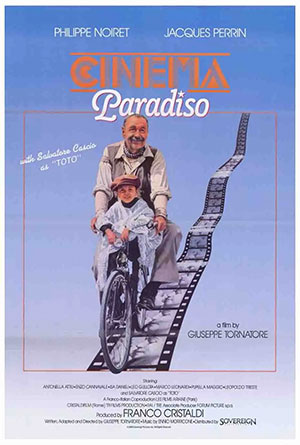

Cinema Paradiso (1988)

Drama/Romance
Profile by John Doe
★8.5
Recommendation 54.3K
Cinema Paradiso

Release Date: 19881117

Director: Giuseppe Tornatore

Cast: Philippe Noiret, Salvatore Cascio, Marco Leonardi, Jacques Perrin

Production: Cristaldifilm, Rai Cinema

Synopsis of the Cinema Paradiso

In a small, sun-dappled Sicilian village, young Salvatore—affectionately nicknamed Toto—finds his escape from the monotony of rural life in the local Cinema Paradiso. Fascinated by the magic of moving images, he befriends Alfredo, the cinema's gruff but kind-hearted projectionist, who becomes his mentor and father figure. Alfredo teaches Toto the ropes of film projection, and the two share countless hours immersed in the stories unfolding on the screen, as the cinema becomes the heart of the village, uniting locals in laughter, tears, and shared emotion. As Toto grows older, his passion for film deepens, and he also nurtures a tender romance with Elena, a young woman from a wealthy family. However, fate and Alfredo's quiet guidance push Toto to leave the village to pursue his dream of becoming a filmmaker, sacrificing his romance and childhood home in the process. Decades later, Toto, now a successful director, returns to his hometown for Alfredo's funeral, where he rediscovers the memories buried in the ruins of the Cinema Paradiso and confronts the love and regrets he left behind. The journey back becomes a reunion with his own youth, as the magic of the cinema he once loved reveals its profound impact on shaping his life.

Detailed Review & Analysis

Cinema Paradiso isn't merely a film about films—it's a lyrical elegy to youth, memory, and the transformative power of storytelling, using the quiet rhythm of a small village's life to unpack the bittersweet truth that growing up often means letting go. What sets it apart from conventional coming-of-age narratives is its refusal to dramatize life's turning points; instead, it lets emotion simmer in the mundane moments: the flicker of light from the projection booth, the warmth of popcorn in a crowded cinema, the silence between Toto and Alfredo as they watch a film together. Unlike previous works that lean on conflict or social commentary, this film's strength lies in its intimacy—it doesn't just tell a story of a boy and his mentor, but captures the universal experience of longing for the past and the way certain places and people become irreplaceable parts of our identity. The film frames cinema as more than entertainment; it's a vessel for collective memory, a space where strangers become a community, and where our own hopes and sorrows find reflection. What makes it unforgettable is its exploration of love in all forms: the paternal bond between Toto and Alfredo, the fleeting passion of young romance, and the enduring love for a place that shaped us. Unlike films that offer clear resolutions or triumphant endings, Cinema Paradiso embraces the beauty of imperfection—Toto's unfulfilled romance, the loss of the Cinema Paradiso, the gaps between childhood dreams and adult reality—reminding us that it's these very imperfections that make life and memory meaningful. What lingers after the credits isn't just the iconic final montage of kissing scenes, but the quiet realization that the stories we love and the people who guide us never truly leave us; they become the soundtrack of our lives, shaping who we are long after we've moved on. It's a film that feels like a hug from the past, a gentle reminder that even as time passes, the magic of the moments that define us remains eternal.

Related Movies

Write a Comment (0)

0/200
☆ ☆ ☆ ☆ ☆
0/10

No comments yet. Be the first to comment!