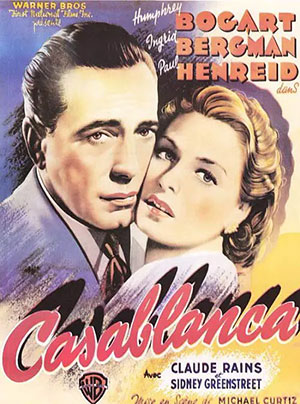


Casablanca (1942)

Drama/Romance/War
Profile by John Doe
★8.5
Recommendation 54.3K
Casablanca

Release Date: 19421126

Director: Michael Curtiz

Cast: Humphrey Bogart, Ingrid Bergman, Paul Henreid, Claude Rains

Production: Warner Bros. Pictures

Synopsis of the Casablanca

Set against the backdrop of World War II, Casablanca—a bustling, lawless Moroccan city—serves as a haven for refugees fleeing Nazi persecution, all desperate to secure exit visas to the safety of America. At the center of this chaos is Rick Blaine, a cynical American expatriate who runs "Rick's Café Américain", a neutral ground where smugglers, spies, and refugees converge. Rick keeps his past buried, refusing to take sides in the war, until his life is upended by the arrival of Ilsa Lund, his former lover, and her husband Victor Laszlo, a renowned Czech resistance leader hunted by the Nazis. Their unexpected reunion rekindles old passions, but also forces Rick to confront a painful truth: Ilsa left him years ago in Paris, not out of betrayal, but because she had believed Victor was dead. Now, with the ruthless Nazi Major Strasser determined to prevent Victor from escaping, Rick holds the key to their freedom—a pair of rare exit visas. As tensions mount and danger closes in, Rick must make an impossible choice: reclaim the love he lost by letting Ilsa stay, or sacrifice his own happiness to ensure Victor's safe passage, knowing his leadership is crucial to the anti-Nazi resistance.

Detailed Review & Analysis

《Casablanca》is far more than a classic romance—it's a profound meditation on love, sacrifice, and moral courage in the face of global chaos, using the intimate drama of two lovers to mirror the larger struggles of a world at war. Have you ever been forced to choose between your own happiness and something greater than yourself? Rick Blaine's journey resonates with this universal dilemma, reminding us that true love often lies in letting go, and that courage isn't the absence of fear, but acting despite it. The sensory details are richly evocative: the smoky haze of Rick's Café, the strains of "As Time Goes By" drifting through the air, the tension in Rick's voice as he confronts Ilsa about their past, the cold glare of Major Strasser as he asserts Nazi authority, the quiet resolve in Victor's eyes as he refuses to compromise his beliefs. What sets this film apart is its nuanced portrayal of moral ambiguity: Rick begins as a man who claims to "stick his neck out for nobody", yet his cynicism masks a deeply held sense of justice. Unlike stories that reduce heroism to grand gestures, 《Casablanca》frames it as quiet, deliberate choices—the decision to put love aside for the greater good, the refusal to bow to tyranny, the willingness to trust others with one's fate. The film also avoids sentimental clichés, instead presenting love as a complex, imperfect force: Rick and Ilsa's romance is passionate but fractured, shaped by regret and circumstance, making their final goodbye all the more poignant. If there's a shortcoming, it's that some supporting characters are given limited development, but this is overshadowed by the film's emotional resonance and thematic depth. What makes this film timeless is its celebration of selflessness: Rick's sacrifice isn't about martyrdom, but about recognizing that some causes are worth more than personal desire. Long after the credits roll, you'll remember the image of Rick and Louis walking off into the fog, discussing their new mission with the Free French, and the haunting refrain of "As Time Goes By"—a reminder that love endures even when it can't be possessed, and that courage is contagious. It's a film that doesn't just tell a story, but captures the essence of human resilience in dark times, a testament to the idea that even in the chaos of war, hope and honor can prevail.

Write a Comment (0)

0/200
☆ ☆ ☆ ☆ ☆
0/10

No comments yet. Be the first to comment!